Showing posts with label Photographers. Show all posts

Friday, November 18, 2011

People in Hereford

I haven't spent a lifetime making photographs, I have spent a little more than half my life occasionally taking photographs and the older I get, the more I think about the photographs that I have made and want to make more of. I have though, spent a lifetime looking at people. I have lived in a large family house, I have six sisters and a brother, I have worked with teams of people in sport and in my career, and I have also directed people on the stage. I perceive I know something about people. The first photographs that I took were pictures of people, family, friends. These photographs had no pretensions, mostly badly lit (or more correctly, inexpertly exposed), sometimes focussed, sometimes not. The photographs though that haunt my memory, those that have lasting emotional content are those that display people. I mean display and not portray. I mean the photographs that reveal something of the person. Karsh's picture of Pablo Casals, Steichen's photograph of George Bernard Shaw, the Bedford schoolboy outside Bedford prison by McCullin, El castigo from the Etiopia 2007 series by Jaime Mota; I could list many more. 

Portraiture isn't without artifice, the photographer interjects a lump of technology into the face of willing or unknowing or uncaring subject and snaps the picture. The quality of the image stems from the photographers knowledge of the subject and the subject is both the object of the lens and the means of recording. To get these images, images that describe the subject in 125th @ f8, that can reveal even the merest hint of the soul of the subject is the grail that portraitists might seek to set them apart from the daily grind of formal portraiture

I had never been to Hereford nor, consequently, the photography festival. My knowledge of Hereford is, to say the least, basic. Somewhere in the west and agricultural, something about beef cattle and dairy products might come to mind. I didn't expect, when I started to drive to the festival to be shocked, to have my eyes challenged and my emotions stirred as they were - and still are. As I write and check my notes, the feelings that were generated then are still as raw.

Two sets of prints stood out for me and they were those by Vanessa Winship, Geogia 2009 - 2010 and Donald Weber's Interrogations: Big Zone, Small Zone.
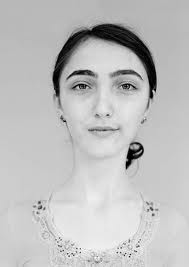
Reproduction by kind permission of the artist, Vanessa Winship

Winship's set of monochrome portraits are absolutely beautiful. Finely crafted prints, with fine technique, any one of which I could gladly have hung on my walls at home, yes, even the one of the young post-operative boy. The images were taken from the Georgia in Progress set and can be seen here  . Georgia is one of those ex-soviet satellites that rejoiced the freedom after the collapse of the Soviet empire, followed by the Rose revolution. The enmity that lies between the Russian state and the Georgian state is almost as old as the ground these people walk on. I remember a radio interview where a Georgian described how some Russians had come over the border and raped and murdered their people and how the kinfolk of the victims sought to avenge the crimes against them. When the interviewer asked when this happened and had they informed the police, could anyone describe the perpetrators, the correspondent said that would be a little difficult as it had happened somewhere in the 12th century. Yet it was told as if it were yesterday. These people who Winship describes as .."And Yet There Is A Kind Of Melancholia, An Underbelly That Almost Inevitably Sets Itself Against Such Exuberance. It Is A Place Literally Crumbling From The Weight Of Such Unsustainable Romance. On My Return In 2008, After A Summer At War With It’s Powerful Neighbour. " (1). The people live the past as if it were the present, I think this is the romanticism that Winship refers to, holding on to a past where the romanticised view of their predecessors are held close to their hearts. No mention was made in the accompanying text to say what instruction Winship gave to her subjects, whether to come "dressed" for the occasion for example national costume, it would be interesting to hear if there were any instructions. I know that for portraiture it is one of the first questions that are asked of the photographer, so I would guess that the subject was covered at some stage. Whilst viewing I heard the name Arbus mentioned in whispered tones, and yes I can see that, but I would be wary not to have the Arbus strap-line of freaks applied to these subjects.

The photographs do contain a certain melancholia, in the way the eyes appear in the close in shots and the way the subjects stand for the full length photographs. It appears they are "straight" shots, no apparent post processing, close to the gossamer of "truth" in both the subject and mood.

I have had a (short) conversation with Vanessa which has resulted in the ability to reproduce the image above and also answered a couple of my questions, these don't alter either my view of her work nor how I understood how she approached her work. Vanessa explained that she asked her subjects to simply look into the lens (which she sometimes pointed out to them) after explaining what it was she was doing and, perhaps in particular the effect of seeing things upside down on the ground glass. Vanessa only made one exposure per subject, she appreciated that it took time to stand still especially as  ".. I would explain that I was going to be a bit slow because the camera is a bit fiddly, and also that I was a bit slow." I asked about the effect of the camera on the subject and Vanessa replied..."In terms of the camera making a difference then I would say more than likely yes, although I think the whole occasion made a difference....I am a stranger, it's an unusual event within the school day, it's not a usual occurrence to have a formal portrait made,( by that I mean to stand momentarily in front of a camera set on a tripod), and yes it's not a telephone camera, nor is it a digital camera." 

On a completely different plane was the work by Donald Weber, where Winship's set was full of peace and beauty, Weber's exquisite beauty stems from capturing a moment and a moment that shook me and moved me. The portraits are of "The Underclass and its Bosses: Crime and Punishment in Ukraine,...". There are many literary connections to this body of work, Weber himself talks of Solzhenitsyn's Gulag Archipelago, which I haven't read in over thirty years, saying "Solzhenitsyn talked about the moment of recognition, he always wondered during his execution what he would look at, would he look up at the sky and look for a bird, or would he look down at the ground, head bowed? It's about a moment of recognition, once that flicker of acceptance occurs, things undoubtedly change. So I was looking for these moments, that passage from knowing what was once will never be again." (2) We can see these interrogatees looking, maybe not for a bird, but surely for divine intervention.

What I also remember about the book is how Solzhenitsyn likened the proletariat to rabbits - and not in the likeable fluffy version. These are portraits of human rabbits staring at the lights of a brutal power in the manner of supplicants. In every shot where the subjects hands are visible, all but one are in a pose of prayer. These will be Orthodox Christians, they are praying for mercy. Weber states that they aren't in a religious confession.. "but there is that idea of purity of confession, that one fleeting glimpse of honesty. That's the moment I found so interesting. It's the closest any of us get to God, and the moment at which everything changes..."(3) Let me be clear, I have no God, I subscribe to the "Gospel of the Flying Spaghetti Monster" by Bobby Henderson - no less serious, despite it's title. Dostoyevsky wrote Crime and Punishment, he was Ukrainian, maybe that is why Weber chose those words, most people fail to make the distinction between Russia and Ukraine (unless you are Russian or Ukrainian that is). Dostoyevsky wrote about the failings of the human condition, about nihilism versus religiosity and in particular of course the Russian Orthodox church. It (religion and the process of confession) is used as a metaphor in the book. I wonder if Weber is referring to this in how he has edited the series. And the final literary reference is to "The Kolyma Tales" by Shalamov that describes life in the notorious labour camps of Siberia and is equally shocking as Weber's photographs, not least because the graphic imagery comes from the readers imagination. I don't think this set panders to the prurient (though it may do that as well), nor do I think that these images or similar shouldn't be shown, just because they shock, they certainly did that for me. I think it is important that images that offer a truth, and here I go back to Weber's words, to the .."fleeting glimpse of honesty.." should be shown. Weber, in this series has given the viewer a real truth in the very pained, clutched and desperate - but who wouldn't be with, what looks like a Tokarev, anointing your temple? And truth, real unexpurgated truth, is a rare commodity in any medium, let alone and perhaps least of all, photography.

These two photographers allow the viewer to grasp a sense of honesty, all be they framed in critically disparate circumstances, one confident that their past informs their present and their future in equal measure and from generation to generation, the other that the past has informed on them and that there may be no future as a result. Both sets edited to draw, at least from this viewer, an emotive response that I am sure will last long in the memory. The one printed to deliver a haunting beauty, the other with a concealed spectre of a wholly different kind

(1) http://www.vanessawinship.com/gallery.php?ProjectID=175

(2) http://colinpantall.blogspot.com/2010/11/donald-webers-interrogations.html

(3) Exhibition catalogue

Sunday, November 13, 2011

Martin Parr at the MSHED

Visiting somewhere for the first time has its ups and downs, finding your way around, navigating the one way systems, the traffic calming, and having to collect rather recollect landmarks, in case you see them again on the virgin trip that you may retrace your steps, they are all part of the visual landscape; all whilst listening to the dulcet tones of Sat' nag.

The visit to the MSHED venue in Bristol http://mshed.org/ which is a lovely museum and art gallery in what was the traditional heart of the city was to view, with the "South West" OCA students group (for which I am a peripheral member), "Bristol and West", an exhibition of photographs by Martin Parr. The exhibits were curated jointly by Parr and the Museum to depict life in and around the Bristol area. The curator gave a talk and was keen to point out that, as the title portrays, the boundaries for selection was Bristol and it's close surroundings. 

"Did we - as viewers of Parr's work - see Parr as from another planet?" The now infamous accusation levelled at Parr by Cartier-Bresson that he was "from another planet" was posed as a question and delivered in a way that suggested that CB was an admirer of Parr's work - I'm not sure that he was admired by CB, from what I understand on the subject and the fact that it took the best part of a decade from when Parr applied to join Magnum to when he succeeded, and then only accepted by a single vote, suggests otherwise. I think that Parr was far removed from the "humanist" vision of CB. But it was a conundrum we were invited to consider as we viewed the images. Another parochial poser from our host was whether we saw any single photograph that picked out a distinct image of Bristol, an archetypal view of this old city that was summed up in a single image? We were also invited to select and vote for our favourite image in the hall. I certainly appreciated the talk - I had visited the exhibition before the talk and knew many of the photographs before coming to MSHED - as it was an opportunity to listen and be engaged by the man who worked with Parr to pull the series together.

There were several sections and the selection from "Cost of Living", "Chew Stoke, A Year in the Life of an English Village", "Clevedon Swimming Club" and others. 

The photography of Parr dwells on the intimate - he has an unnerving capability to move in close to his subjects, to highlight, often with the use of flash in full daylight, those moments which display what he leads the viewer to believe is a revealed truth (so many photographers trade in the word truth, it seems to me that they do protest too much). The curator was at pains to remind us that Parr wants us to believe these verisimilitudes delivered by his lens, these tiny moments extracted from, as he freely admits, thousands upon thousands of images - the original down-select was 600 from which the exhibition displayed 60, are indeed reflections of us as society members. I shall return.

It is impossible for me to divorce politics from his imagery - once described as Thatcher's favourite photographer and yet commissioned by the Guardian to depict the "Cost of Living"1989, the wreckage of post Thatcherite English society, a set that itself has been charged with "photo-rape" (1) by the apparent middle class "victims" of Parr's lens. Yet he undertook the commission to depict "A Year in the Life of an English Village" from the Telegraph - Thatcher's most ardent supporter and still looking for her mantle bearer to shine forth. Cynicism is another on the charge sheet for Parr, certainly opportunism and commercial at that, ipso facto the need for recognition via Magnum.

Parr's photography comes with baggage. It is difficult to decouple the image from what made it. Parr knows that by using a ring flash in the middle of summer (even an English Summer) it cannot go unnoticed, neither then can his subjects. It is stretching credulity to imagine his technique, however refined, will leave his subjects and their environs unfettered and untouched. He therefore interjects an artifice in both presence and by his process which will deliver greater levels of colour saturation, which HE decides to leave in; it is his conscious decision to leave his subjects and their surroundings bathing in a stretched gamma. These decisions and actions must predicate an stylism that means to take the viewer on a journey.

The apparent reflectionist quality of Parr's work positively craves the viewer to offer a critique on each image, whether it is the apparent "sniffiness" of the portrayed "Middle Aged, Middle Class" white couple disdainfully engaging with the dark skinned person in "Royal Commonwealth Society function for a summer evening"  - part of the "Cost of Living" series or, the "Bristol 2000" photograph of the bowls player stretching his back during a game in a bucolic vision of "typical English village life" - an idea that I would refute from a personal perspective, but that is a separate and distinctly different issue. Our invitations to construct narrative imbue every photograph selected, down-selected and final edited for the viewer - an editing journey with its own narrative to begin with.

I needed to listen to the unnerving tones of the nag to navigate my way home, This artificial construct of technology that recognises where I am and where I want to go delivers messages that direct me to an agreed point. As I travelled I started to think more about this exhibition, the photography and MSHED. I think Bristol is lucky to have this venue and I look forward to returning, to recollect my journey, it's landmarks and maybe stay a while longer to breathe in the traditions of this interesting city. The exhibition was curated to pose a Bristolian view of Parr's work, I have to say that in this respect, for me, it failed. Parr's imagery is pan western 3rd world; apart from one street sign there were no direct references for me that this was pinned to Bristol - even the directive titles didn't move the print to a recognisable gps reference that my nag could have brought up in "interesting local sights". Parr is an emigre to Bristol, born on the chalk hills of the Downs, his adopted home, one of many, perhaps shows his peripatetic photographic traits, equally at home in New Brighton as in St Pauls; as one of my colleagues at the exhibition said "I've been here (Bristol) for over 30 years now, but it's still too early to call it home.

As with my nag, the photography of Parr is predicated on artifice. It is an interjection of technology and technique that, whilst certainly not unique, delivers to the viewer a highly edited view of Parr's dystopian world view. We are at times invited to sneer at both people and environment and at times to regret the passing of an idyll that is delivered on a (deep red) rose tinted glass. Both will lead us to predetermined destinations and whilst that is the strength of my fellow traveller it is, for me, the only weakness for Parr.

1 Bristol Evening Post, (Bristol, England), Thursday, November 16, 1989, p-7

Sunday, October 30, 2011

The Blues and the Abstract Truth

Oliver Nelson one of the great composers and arrangers of the sixties and early seventies contemporary jazz music scene shot to fame with his seminal album, titled above. The luminaries that he collected for this album, including Eric Dolphy, Freddie Hubbard, Bill Evans and others place this album amongst the great recordings of modern jazz. Recorded in 1961, Nelson’s career last only until 1975 when he died of a heart attack. It is one of the “coolest albums” of the genre and recommended, not least because it contains some images by Chuck Stewart .


Digressions aside – the most famous track on the recording, which opens the album, has become a standard in the jazz repertoire, the composition that established Nelson’s name in the genre is in a melancholic C minor key, namely “Stolen Moments”. Nelson writes “As a player, I became aware of some of the things that I knew existed, but I was afraid to see them as they really were.” cover notes from the aforementioned album sleeve.

In photography the “decisive moment” is illusory, there is no moment; there may be a variable period when a recording takes place that smudges across time. The myth of the revealed truth in any frame at any stage was surely debunked a century or more ago. Similarly the concept of analogue photography versus digital, when all along, and today still, there is only digital photography, not just that process is initiated by the digit, but the shutter is closed, then opened, then closed. The recording, however, is every bit as analogue today with the latest of sensors as it was when Fox Talbot made his first exposures. The differences today with the “digital” camera and the “analogue” camera are the levels of remove between the eye (the mind and imagination) and the end image.  The frames of moment/time and of the encapsulated visage through the lens are the twin determinants that the artist can provide some control over; these twin choices are both in the gift of the photographer, both are conscious decisions in the process of capturing the slough of moments that will end up on the exhibition wall or, more likely, the "back up" recycle bin.  The momentary and impermanent nature of the image through the viewfinder provides the photographer with the greatest level of control over the final image; it is only these two devices, which have been ever-present since the development of the captured image, that can link the camera operator with any vestigial claim on truth associated with the end print.

Staying with today’s technology and the transience of space and time; the abstraction that divides the photographer from any final image displayed on screen, wall or the round filing cabinet are now so prodigiously wide that some photographers spend more time interpreting the physical limitations of the processes of image development more than image creation itself. To compound the lack of control, in this erstwhile manual process, is the relinquishment of the governance of truth, of the embryonic image, to the levels of abstraction, layered and blended in ways by which no single man alive can fully determine or deconstruct. The initial abstraction that removes the taker from the “reality” starts with the technology of sensor construct, the algorithms of cell composition, digital signal processing, the formulaic colour management, focus and sharpening before the finishes via, whatever "post processing" the artist feels is required, to an eventual image re - production via excursions of software, printer hardware and their concomitant profiles, ink recipes, which again the photographer may, or may not, make an attempt at craft control.

If Nelson was "aware of things that existed, but was afraid to see them for they really are" then what do we as photographers, as recordists, for recording is what we can do best, respond when we see things and attempt to portray them as they really are? For us, as photographers, the truth is an ephemeral concept, it is abstracted away from us the moment the shutter release is allowed to instigate the process of recording and every event in the subsequent in the chain of command further decouples us away from reality.
I have for a long time particularly enjoyed Nelson's signature composition "Stolen Moments", it's soulful development of the 16 bar piece is both lyrical and contemplative. It's title though now excites another lever to consider when looking for any "moment" to record. Just where does the truth lie?


Saturday, October 8, 2011

Glamour of the Gods

At the National Portrait Gallery, and other thoughts.

Formal portraiture is a difficult genre to pull off well, perhaps no more or less than any other genre, but nevertheless the formal portraitist has something to contend with that a landscape photographer doesn't have - ego and emotion, and these aren't necessarily only confined to the sitter, because to make it work the sitter has to deliver at the time of shutter release. The sitter has to provide the artist something to work with, something indeterminate that a formal portraitist, that works in non - photographic media - paint, pencils etc, can work without for large periods of the creative process, as long it becomes apparent to the artist at some stage then it can be integrated into the study, whereas the photographer has to generate an emotional charge between artist and sitter - something has to happen between them.

The "Glamour of the Gods" show at the NPG has formal portraits of, generally (I can think of one exception) actors and actresses that "want" to project, who "want" to deliver and find a relationship with the lens, the photographer and the viewer as without it they are redundant as performers. Greta Garbo had a difficult relationship with the camera and is the only exception I know of with the "stars" of "pre-war" Hollywood that this exhibition is all about. I will, however widen the scope of this entry to include other formal portrait photographers that I have some awareness of - which may limit the breadth of the entry!

I suppose my entry into this genre stems from a strong regard for film noire, watching old black and white movies as a youth, my own predilection for monochrome work and I have loosely studied this genre for a few years and started some projects of my own which I may refer to later in this entry.

The exhibition in itself was interesting and varied (inasmuch as this sub genre can be varied) and enabled me to look closely at the print quality that so far I have only seen from reproductions in books. Overall I would say that my prejudices were confirmed and it was wonderful to see these iconic portraits in the flesh, as it were.

                                                                     George Hurrell


George Hurrell's work stood out as I expected it would and showed an artist and craftsman at the peak of his ability and his iconic images of Shearer, Crawford, Bergman, Harlow were every bit as beautiful as I had come to know. Whilst this isn't a comment of how Hurrell came to be one of the leading studio stills photographers it is likely that I will return to his work to illustrate his technique and how others adopted similar working practices in the furtherance of this medium.

When I first started to look into this genre I didn't notice how expertly these portraits of the stars had been worked, how they had been retouched, maybe that's a naive position to start with, after all it's called "photoshopping" now. But when I researched it a little some years ago I found to my surprise how much retouching had gone on. And, as always, once you know its there it's difficult not to notice it anymore. In the first couple of decades of the last century the technical quality of retouching was relatively weak and the photographer relied on heavy diffusion to disguise he imperfections of their protege stars and starlets.

An exemplar of this retouching technique is shown below.


The twin shots above have become common currency in the discourse regarding touching, however it is still interesting to see how far the studios were prepared to go to create the illusion of what they considered perfection, for that is what Gods are. Joan Crawford's face becomes devoid of wrinkles, lines AND freckles. Hurrell would ask that his sitters wear little or no makeup when coming to him as this would enable him to work things more efficiently.

These techniques were applied to both sexes and as the technical capabilities and craft improved both genders received higher levels of sophisticated retouching and whereas the male stars generally fared better it did become completely over the top in some less than capable hands by the ends of the 1930's and early 1940's. The universal process or retouching largely died out after the second war as the studios went for a more "realistic" look but is now is as pervasive as ever with Photoshop and the star machine working as hard as ever.

I'm undecided about the moral and ethical issues at work here. Clearly there are victims here, but it isn't necessarily easy to work out who. The stars? The viewing public? Impressionable youth? The impressionable?

Humphrey Bogart

Hurrell's technique developed over several decades and used quite dramatic lighting and was said to have said "it doesn't matter where the light falls, it's where the shadows land". But the whole process of star making changed after the war and with it went the 8X10 cameras for a more convenient camera capable of more shots more conveniently, allowing for more mistakes with faster emulsions, that delivered finer and more controllable grain and wider tonal range. In came colour and whilst Hurrell adopted it, the effects that he had created, along with the others of the pre-war era were never quite re-created (in my view).

Norma Shearer                                                                                  Jean Harlow


Norma Shearer gave Hurrell his first big break and there are a lot of Hurrell/Shearer shots and he loved photographing Harlow also, almost as much as she liked having her photograph taken.

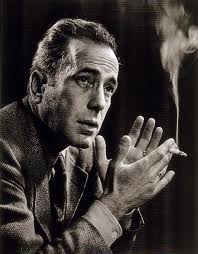
I've placed an alternate portrait of Bogart with one by Yousuf Karsh. I think there is a great similarity in the projection from the print,. The portrait of Pablo Casals is a far more enigmatic pose. Hurrell wasn't about delivering the soul of the sitter, more mystique, Karsh, who by the time he got to photograph Casals was able to pick and choose his subjects and, to some extent, dictate the delivery style.

‘I decided to photograph the master of the ’cello from the back, in a partially restored abbey in Prades … lost in his music. For me, the bare room conveys the loneliness of the artist, at the pinnacle of his art, and also the loneliness of exile.’ (Karsh)


Prades is in South West France and Casals appeared there as a regular during his exile from Franco's Spain. If the viewer is in the North then the light would be coming from South West - Spain, an interesting thought. I've seen a print of the Casals and others by Karsh in the hotel in Ottawa where he had a studio for many years. That are very impressive in size and ambition.


Some views and my own interpretations:


Rebecca, left simply shot on a diagonal flow, with a single tungsten lamp above and left, creating a strong shadow, the image on the right is my take of the Louise Brooks portrait by Eugene Robert Richee, itself inspired by Aubrey Beardsley's pen and ink work (something very familiar to me from student days). Again a single tungsten lamp this time high and right. I have to say that my piece is far too fussy.

The images of Lisa were drawn from the stills of Hurrell and my attempts to add a dramatic element, as if from a film set - these Hollywood stills photographers had just a few minutes between takes to create their publicity shots and sometimes seconds!

Unlike the shots of Rebecca these were digital captures as I wanted to start to develop my re-touching skills (I also took a large number at the same session with film). Single tungsten lamp. The shot left has a Hurrell Crawford shot in the back of my mind and the opposite image has a Shearer shot where Hurrell brought her legs into view to prove that her concern over "my legs are one of my worst features" could be shot to her advantage.

Madeleine was a ballerina with the Royal and has a very significant photographic background, her father, a professional photographer, pioneered Kodak into the UK. Together with her husband, also a professional photographer combined to have her posing from the age of 3 (she didn't tell me this until the first posing session! No pressure there then!).
However, whilst the shot left, taken with a 6X6 on Ilford Delta 100 - no orthographic film for me, that laid the basis for Hurrell's early work and reputation. The second shot is from a series where I attempted to recreate some of the glamour practices from todays photographers, so digital and a lot of re-touching. I worked very hard to eliminate any wrinkles, lines, imperfections that would be anathema to today's photo stars. The link of course is that Madeline has a direct connection both with the era from which I draw inspiration - I have seen her portrait with Danny Kaye and others from stage and screen with photography being the another connection

Friday, September 16, 2011

Toshio Shibata

I'm not entirely sure why, but my tutor suggested that I look at the work of Toshio Shibata a contemporary Japanese photographer - and I'm very glad he did.

I have a high regard for what little I know of Japanese art and what I do know seems to have some parallels and that is maybe why I am drawn to Shibata's work. Until now I had been aware of Japanese literature in the form of (amongst others) Ishiguro and Murakami, both of whom I have read (I think) all they have had published. The link between them is the West. Ishiguro moved as a child to the UK and is now a UK citizen, Murakami travelled extensively and lived in the USA whilst Shibata studied in Belgium. I wonder if I find it easier to connect to these artists because of their sensitisation to Western culture? It is true that Ishiguro is the least "Japanese" of the three, the others having resettled back in Japan, but both Murakami and Shibata created work whilst in the West - something to think about later.

Shibata studied fine art at the Royal Academy Ghent and started to use the camera as part of his creative process. The camera, and the mages he created with it, started to become his metier and is now his primary form of image creation. Later Shibata was impressed by the work of American photographers such as Adams at an exhibition in Paris and later, when he went to America he found others, such as Weston and Meyerowitz - these were to become a major influence on his later work.

When he returned to Japan he started to photograph mainly at night, at toll booths and garages - as below.

These shots are typical of his early period and are dissimilar with his oeuvre that he has become synonymous with. It is interesting that he was unafraid of using negative space in these shots and there is very little in his later work.

Note the lack of Sky!


However, the work that has brought him attention is his "Infrastructure" project; it is monumental in scale, in fact the subjects are so large that they are in danger of losing their proportions in the frame and the viewer is constantly looking to reinforce the understanding of the photograph by looking for a scale reference. Shibata notes in an interview (referenced below) that the Japanese are proud of their  infrastructure projects, they positively rejoice having one in their own back yard - no nimbyism here! - and it is worthwhile noting also that Shibata is taking (see note on not being able to make a photograph) his images from completely accessible places - I wonder if they would be cordoned off in the West?

 These hugely impressive photographs are exactly that to me - huge in scale but dispassionate, they adhere to a some of the very basics in composition: diagonals for dynamism, thirds and  symmetry for balance. But, they do not show the sky at all. I have looked to try and find some evidence of the sky and I found one picture that had a twilight sky. The night shots do not have any detail in the black space above the subjects - just a curious point.


Toshio Shibata quoted as below;

I employ a particular kind of sensitivity for approaching landscapes and sceneries like still lives. It's in way as if I was placing them right in the palm of may hand for examination. That's why I never included the sky. Showing the sky would mean going back to depicting landscapes.

There are a few other things that I always keep in mind when photographing. Grasping the subject matter instantaneously, for example, and leaving the scene before beginning to think about the subject's meaning.

I also avoid gathering too much information about the location of a shoot. Not letting knowledge affect the work is essential. And ultimately, I'm eradicating my own presence, as ideally I only exist as something that quietly releases the shutter between the film and the subject. 
This is how I try not to charge my photographs with emotion, but present the subject matter plainly, as I believe that this method takes me to new and unknown areas that I can explore. I'm considering photography as a medium that involves these kinds of possibilities.

My works are sometimes classified as abstract photography. I am in fact keen to depict my subjects faithfully and without missing out the tiniest details, so this idea seems a little odd.

Abstractness in photography surely does not refer to superficial elimination imitating the characteristic presentational forms and features of abstract painting. On the contrary, I would rather say that it's about a variety of connotations and possible interpretations evoked in the imagination from a distance that is created by depicting the subject matter in as plain and impassive a manner as possible.


Note in the above quote - first paragraph That's why I never included the sky. Showing the sky would mean going back to depicting landscapes. Yet his books have the titles "Landscape" and "Landscape 2". 


It is both curious and interesting to me that both Murakami and Shibata have abstraction/surrealism a base element in their art. Murakami is a great aficionado of Jazz - he ran a Jazz club for a long time in Tokyo and his affection for modern jazz from the likes of Ornette Coleman and John Coltrane whose abstractions would have been very different to the rigid formality of Japanese culture, both then and now. 


Shibata's imagery, by his own admission is dispassionate, devoid of emotion, a record - all of which is very typical of Japanese culture - he is very careful NOT to place himself, or his shadow, in the picture. It has nothing to with him. These images, that he says could be held in the palm of one's hand, are in reality, huge human projects to wrestle with nature, to attempt to tame it. He doesn't attempt to comment on the image and I don't think he intends to celebrate it either - they seem more like statements of fact, abstracted from their position, without reference in many cases to depict their enormity.


http://www.eyecurious.com/interview-with-toshio-shibata/


http://www.someslashthings.com/blog/toshio-shibata-dams-in-somethings-magazine-chapter004.html


"The only elements that you can control are contrast and tonality, light essentially. With painting all the 'unnecessary' parts in a scene can be eliminated. With photography, you just have to accept what is there. That is where the difficulty of photography lies. Photography is not something that you can make. It cannot be forced. You have to accept the subject. "  http://www.eyecurious.com/interview-with-toshio-shibata/


Sunday, September 11, 2011

Notes from 3 exhibitions. Friedlander, Day and The Hungarians


Three shows when I only anticipated two – thanks to Miriam, who had spotted a Corinne Day show close by the Friedlander, that we fitted in between the latter and the Hungarians at the RA.

Lee Friedlander

The Timothy Taylor had two bodies of work: America By Car and The New Cars 1964. Typically (for me) I started to view the prints from the end of the show and worked backwards – this has the drawback of not getting the notes surrounding the images at the appropriate time, but it is something I’ve also found to be a benefit in that I’m not preconditioned to respond in any way. The America By Car series has been well documented so I wasn’t surprised by the structure of the prints and my initial reaction was that Friedlander, it would appear, has come from a background in “fine art photography”. 


 Lake Louise


The images are generally well processed, quite sharp - as you’d expect from the equipment he used - and fine grain monochrome. I found it interesting that in a number of the shots there were snatches of he great American landscape – the Tetons, Montana, which suggested a connection between what this series was about and the tradition of Adams, Weston etc., something that I might look into later. However I also thought that the technical quality could have been improved with some spotting and cleaner processing.


The “America” series relied on a very limited set of viewpoints and (most of them) had a dynamic composition that moved the eye across the image in a natural way. The compositions being:

            Across from the drivers position to incorporate the wing mirror, side window, the top of the driver door (at the base of the window).


            Through the passenger window, with a similar construct as above.


            Through the windscreen, slightly to the right of the steering wheel.


            Straight out of either the drivers window, or the same again through the passengers window.


The mirror – in some shape or form - appeared in all but about six prints. The mirror is a very creative device and can be used to deliver all sorts of information, messages, allegories and I’m not sure whether the mirror is there because of the angle of view, or whether it was deliberately placed in the frame. For some of the shots the case is clearly made for its deliberate inclusion with either Freidlander looking at us looking at him and, when another person is captured clearly moving into the frame via their own reflection. Other mirror inclusions had a blank screen and at the moment I am undecided on this point.
Quite a few of the images had a deliberate inclusion of text, from various signs: road signs, hotel signs, entertainment signs, religious signs which all invite us, as the readers, to conclude and propose a context for the images.

The America series focused on America, the land and the people – more specifically on the “blue collar” life – there were no privileged situational shots. It was trucks, trailers, parking lots, shopping areas, seedy bars and almost devoid of people – there were a few, maybe five or so, that featured people.

Movement, the lack of it, was another key element in this series. The “Car”, being the tripod to ensure both that the shot is not suffering any camera movement is used to ensure the view is clear. The camera is static, the subject is static, the monumental exteriors whether they are mountains, parked trucks, building’s and even the very few people seen in the shots are static. It is therefore then a record of a time and space as seen through a car window with the car not performing it’s function as the emblematic consumer product that typified the American dream of freedom more than any other product in American history. And it is Friedlander himself who provides the only movement in the 192 prints in the “America By Car” series. It is he alone, in the parting shot entitled “Lee”- a self-portrait of Friedlander, looking into the “Car”, at us, the viewer, that by pressing the shutter release cable with his finger, reveals the only movement. And he must surely have known that would have done so, he would surely have seen that in the negative and the print that he used as his parting shot for the series.

My overall impression from the “Americans” was that it may have started as an accident – a shutter released whilst getting out of a car, which produced serendipitously both an interesting composition and a reflective image, both from the detail within the frame and with the inclusion of the mirror – but it sparked the generation of a body of work that reflects personally on the USA. The use of a car perhaps emphasizes the continual transience of that society at that time, is still relevant today. There were 192 prints in this set which all seemed to be saying the same thing; taking the viewer to similar uncompleted resolutions, similar ambiguities, similar unfinished puzzle and relying on the viewer to conclude.

The New Cars.

Again I started the viewing of the set from the end of the show and worked backwards. My clear impression as I did so was that this series, whilst it featured cars, had nothing in common with the other set. It recorded the car in its environment, bringing it to the fore and setting it in the background, but always the automobile and it’s position within the society was the key to the shot. No mirror shots this time!
It therefore came as no surprise that this set was a commission to produce accompanying pictorial content for a magazine featuring new cars for the current year 1964! Well, despite, the editor spiking the shots which weren’t seen for many years, Friedlander succeeded – well at least as far as I was concerned. The images often sublimated the car within the environment using various devices such as a reflection in a shop window (where he sometimes included himself) or behind a stack of used car tyres. But it was the “Car” that provided all the context and reference, whereas in the previous series it is often left to the viewer to provide the context and reference – based on signage, what was in the mirrors or what was outside the automobile. This advertising set succeeded to portray the car front and foremost, even when sublimated and the editor seems to have missed an opportunity. The series seemed to suggest that the “Car” was an integral part of the community; it’s physical presence and it’s spirit is omnipresent in the life and culture of American life and when there wasn’t one “car” in shot there were multiple cars.

There was less to bring to this series than the “American By Car” series and its substance was less for it.


http://www.galeriezander.com/de/artist/lee_friedlander/works

Jan's blog entry for this which helped me locate some images;

janfairburnoca.blogspot.com/2011/09/lee-friedlander-timot...

I certainly felt challenged by these prints, I wanted to question almost all of the "America by Car" set and to that extent it was a worthwhile experience.

Corinne Day

The Face at the Gimpel Fils Gallery.

The exhibition had twenty prints taken from Day's work with "The Face" magazine. The images are of Kate Moss in the main and I think reveal nothing about Day - they were in the main fashion shoots and therefore say more about the model or the clothes/lifestyle; which in turn says something about Day in as much as she hasn't imposed herself on the image. With only twenty shots it is difficult to draw any conclusions. So I didn't.


The Hungarians

The exhibition at the RA covered Hungarian photography from most of the last century – with a copy of Kertesc’s “The Boy Sleeping” his oldest know surviving print. My initial impression is that whilst these photographs come from a very wide time period (in photographic terms) it has been curated to depict a common desire for pictorial images. Whilst there are significant number of surrealist images there isn’t a hint of post-modernism. These are photographs from the pictorial school, it’s a take-away exhibition, very little investment is required from the viewer as the photographer has provided the context the references (maybe in some cases too many, I’ll come to that later) and delivered with very high quality – I took away the print book and I have to say that I’m slightly disappointed with that as the print quality is about a grade, to a grade and half short of the real thing – I suppose cost is the issue.

As I consider the range of images on show I’m thinking that photographers on the course could see virtually all the aspects of “The Art of Photography” in one place, barring the colour work! The essential compositional constructs covered in the course are all in evidence, lines, points, diagonals, triangles and narrative. People and Place is similarly covered with bold coverage of urban, rural, war, nude and fashion all covered – though the curator of this exhibition could have had a wider nude content, but that is a mild criticism. The counter to all this is that a good deal of the images would have subverted the course’s early instruction with compositions that defy the ordered structure of the course, but that is a conversation to be had at a different time.

The work by Brassai is very impressive, the scale of his ambition matched by the ambitious scale of his photographs, the “Festivities in Bayonne” and “Meadows in the Isere Valley. The decision what to include and to discard must be very difficult and whilst “Bijou of Montparnasse” below left and the “Prostitute Playing Russian Billiards” were included but there is a significant body of work that seems to have been omitted such as the nudes and the homosexuals – below.


Bijou of Montmartre, 1932 (gelatin silver print)
Brassai (1899-1984) Bridgeman


Kertesc, perhaps the “father” of the Hungarian school of photography is perhaps my favourite of these photographers on show, he prided himself on recording his subjects – not leaving his “signature” on the image, except by its absence. He was never formally taught photography and after a hesitant start he set a trail that most others have followed. It was Cartier-Bresson who said “whatever we have done, Kertesc did first”.

 The opening print – Kertesc’s oldest original print “The Boy Sleeping”, composed on the diagonal, with triangles, implied triangles liberally sprinkled on the image and this is before he decides to make a career out of photography. “The Lovers”, which seems a very intimate shot for an amateur was again shot before he uprooted to Paris in 1925 ten years after he took this, when he was a serving soldier. Simply composed on the diagonal in much the same way as the photograph above left.


It was after he got to Paris and before he went to America (to escape persecution from the Nazi threat) that he performed his most daring and adventurous photography that others followed in his wake. Keretesc’s work with surrealism and other modern art movements in Paris paved the way for Brassai et al.
I found the print “Elizabeth and I” the most poignant and he has several versions of it the full length version:

 and, for me, the most telling:


Moholy-Nagel and Munkacsi are both well represented as well as a significant number of other photographers. Whilst several of Robert Capa’s images are now very famous I am troubled by the staged manner of some of his photographs, especially “Drinking Tea at the Refuge” London 1941, but his “Woman Who Had a Child with a German Soldier, Being Marched through the Street” Chartres 1944 is a frightful image.


As I have said earlier, this is a take-away exhibition. It seems unlikely that the viewer would not come away with something from this show and probably a lot, the range of images, the different print techniques, many differing sectors of the photographic art-form are all represented.


 I enjoyed this exhibition enormously, the variety, the substance. I felt at home and comfortable with the genre.