Showing posts with label portraits. Show all posts

Saturday, October 8, 2011

Glamour of the Gods

At the National Portrait Gallery, and other thoughts.

Formal portraiture is a difficult genre to pull off well, perhaps no more or less than any other genre, but nevertheless the formal portraitist has something to contend with that a landscape photographer doesn't have - ego and emotion, and these aren't necessarily only confined to the sitter, because to make it work the sitter has to deliver at the time of shutter release. The sitter has to provide the artist something to work with, something indeterminate that a formal portraitist, that works in non - photographic media - paint, pencils etc, can work without for large periods of the creative process, as long it becomes apparent to the artist at some stage then it can be integrated into the study, whereas the photographer has to generate an emotional charge between artist and sitter - something has to happen between them.

The "Glamour of the Gods" show at the NPG has formal portraits of, generally (I can think of one exception) actors and actresses that "want" to project, who "want" to deliver and find a relationship with the lens, the photographer and the viewer as without it they are redundant as performers. Greta Garbo had a difficult relationship with the camera and is the only exception I know of with the "stars" of "pre-war" Hollywood that this exhibition is all about. I will, however widen the scope of this entry to include other formal portrait photographers that I have some awareness of - which may limit the breadth of the entry!

I suppose my entry into this genre stems from a strong regard for film noire, watching old black and white movies as a youth, my own predilection for monochrome work and I have loosely studied this genre for a few years and started some projects of my own which I may refer to later in this entry.

The exhibition in itself was interesting and varied (inasmuch as this sub genre can be varied) and enabled me to look closely at the print quality that so far I have only seen from reproductions in books. Overall I would say that my prejudices were confirmed and it was wonderful to see these iconic portraits in the flesh, as it were.

                                                                     George Hurrell


George Hurrell's work stood out as I expected it would and showed an artist and craftsman at the peak of his ability and his iconic images of Shearer, Crawford, Bergman, Harlow were every bit as beautiful as I had come to know. Whilst this isn't a comment of how Hurrell came to be one of the leading studio stills photographers it is likely that I will return to his work to illustrate his technique and how others adopted similar working practices in the furtherance of this medium.

When I first started to look into this genre I didn't notice how expertly these portraits of the stars had been worked, how they had been retouched, maybe that's a naive position to start with, after all it's called "photoshopping" now. But when I researched it a little some years ago I found to my surprise how much retouching had gone on. And, as always, once you know its there it's difficult not to notice it anymore. In the first couple of decades of the last century the technical quality of retouching was relatively weak and the photographer relied on heavy diffusion to disguise he imperfections of their protege stars and starlets.

An exemplar of this retouching technique is shown below.


The twin shots above have become common currency in the discourse regarding touching, however it is still interesting to see how far the studios were prepared to go to create the illusion of what they considered perfection, for that is what Gods are. Joan Crawford's face becomes devoid of wrinkles, lines AND freckles. Hurrell would ask that his sitters wear little or no makeup when coming to him as this would enable him to work things more efficiently.

These techniques were applied to both sexes and as the technical capabilities and craft improved both genders received higher levels of sophisticated retouching and whereas the male stars generally fared better it did become completely over the top in some less than capable hands by the ends of the 1930's and early 1940's. The universal process or retouching largely died out after the second war as the studios went for a more "realistic" look but is now is as pervasive as ever with Photoshop and the star machine working as hard as ever.

I'm undecided about the moral and ethical issues at work here. Clearly there are victims here, but it isn't necessarily easy to work out who. The stars? The viewing public? Impressionable youth? The impressionable?

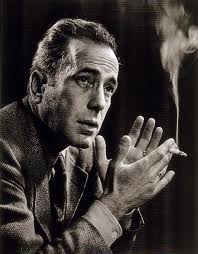
Humphrey Bogart

Hurrell's technique developed over several decades and used quite dramatic lighting and was said to have said "it doesn't matter where the light falls, it's where the shadows land". But the whole process of star making changed after the war and with it went the 8X10 cameras for a more convenient camera capable of more shots more conveniently, allowing for more mistakes with faster emulsions, that delivered finer and more controllable grain and wider tonal range. In came colour and whilst Hurrell adopted it, the effects that he had created, along with the others of the pre-war era were never quite re-created (in my view).

Norma Shearer                                                                                  Jean Harlow


Norma Shearer gave Hurrell his first big break and there are a lot of Hurrell/Shearer shots and he loved photographing Harlow also, almost as much as she liked having her photograph taken.

I've placed an alternate portrait of Bogart with one by Yousuf Karsh. I think there is a great similarity in the projection from the print,. The portrait of Pablo Casals is a far more enigmatic pose. Hurrell wasn't about delivering the soul of the sitter, more mystique, Karsh, who by the time he got to photograph Casals was able to pick and choose his subjects and, to some extent, dictate the delivery style.

‘I decided to photograph the master of the ’cello from the back, in a partially restored abbey in Prades … lost in his music. For me, the bare room conveys the loneliness of the artist, at the pinnacle of his art, and also the loneliness of exile.’ (Karsh)


Prades is in South West France and Casals appeared there as a regular during his exile from Franco's Spain. If the viewer is in the North then the light would be coming from South West - Spain, an interesting thought. I've seen a print of the Casals and others by Karsh in the hotel in Ottawa where he had a studio for many years. That are very impressive in size and ambition.


Some views and my own interpretations:


Rebecca, left simply shot on a diagonal flow, with a single tungsten lamp above and left, creating a strong shadow, the image on the right is my take of the Louise Brooks portrait by Eugene Robert Richee, itself inspired by Aubrey Beardsley's pen and ink work (something very familiar to me from student days). Again a single tungsten lamp this time high and right. I have to say that my piece is far too fussy.

The images of Lisa were drawn from the stills of Hurrell and my attempts to add a dramatic element, as if from a film set - these Hollywood stills photographers had just a few minutes between takes to create their publicity shots and sometimes seconds!

Unlike the shots of Rebecca these were digital captures as I wanted to start to develop my re-touching skills (I also took a large number at the same session with film). Single tungsten lamp. The shot left has a Hurrell Crawford shot in the back of my mind and the opposite image has a Shearer shot where Hurrell brought her legs into view to prove that her concern over "my legs are one of my worst features" could be shot to her advantage.

Madeleine was a ballerina with the Royal and has a very significant photographic background, her father, a professional photographer, pioneered Kodak into the UK. Together with her husband, also a professional photographer combined to have her posing from the age of 3 (she didn't tell me this until the first posing session! No pressure there then!).
However, whilst the shot left, taken with a 6X6 on Ilford Delta 100 - no orthographic film for me, that laid the basis for Hurrell's early work and reputation. The second shot is from a series where I attempted to recreate some of the glamour practices from todays photographers, so digital and a lot of re-touching. I worked very hard to eliminate any wrinkles, lines, imperfections that would be anathema to today's photo stars. The link of course is that Madeline has a direct connection both with the era from which I draw inspiration - I have seen her portrait with Danny Kaye and others from stage and screen with photography being the another connection

Monday, August 29, 2011

Seek and ye shall find

Thoughts on photography as Art, reflections on reading so far.

I read "The Photograph" by Clarke soon after I received the course materials, I already had (and have now re-read) "The Photograph As Contemporary Art" by Cotton and "The Genius of Photography" by Badger having watched the television series and now re-reading again.

There are a number of things that strike me, firstly the likelihood that the same photograph will turn up in each book to illustrate a point. This concerns me a little in that whilst the image itself may have significant relevance to the chapter or genre being discussed, it would benefit the reader/researcher to have more variety to consider, otherwise the genre may tend to be considered a little narrow. This tends to suggest that more work needs to be done (by me) to investigate some of the photographers, to try and put some context to the text, in as much as it relates to what the authors is trying to relay vis a vis the photographers work and intention. There is a tendency to look at individual images and think that could be a "jumping-off" point for my own work. The seemingly straightforward compositions, especially of the still life work - which may or may not be atheistically pleasing - could quite readily be "cloned" and used to make similar images, in appearance at least. I suspect that when I have looked at more examples of the artists work it will help me put their work into perspective.

Clarke's book was less pleasing to read as it contained, for me at any rate, a number of contradictions which I have covered in previous entries - War and Peace and Confused already and I felt more at ease with Cotton's book. Both books, together with the Badger publication looked at how some modern photographers looked at, as Cotton described "Intimate Life". The photographs seem to be taken at the periphery of life (albeit intimate studies) and whilst I agree that they are "intimate" shots, I am a little concerned that it is the viewers prurience that is being pandered to. I saw an exhibition of Corinne Day's work (or it might have been photography that included Day and another's documentary of Day)  at the Photographer's Gallery some years ago which did detail the excruciating process she went through with the brain tumour. I can appreciate the bravery of the decision to record it, as there was no guaranty that there would be positive conclusion to the process. It was moving, I did feel shock and awe, but I came away thinking that it was the the image that shocked, rather than the emotive force that fed the creative process in its creation; much in the same way that Weegee's images shocked New Yorkers in the middle of the last century. Could it be that both of these photographer's contribution to the medium is as recordists of the society at the time? However Richard Billingham and Nan Goldin have both earned significant reputations as photographers almost by happenstance. Both recorded life as it happened around them, Billingham to gain material for his painting course and Goldin to record her life and that of her close friends - much in the same way that Facebook users do today. Both of these photographers work again seem to pander to the prurient and both photographers work have been legitimised by their having studied in either "Liberal Arts" in Goldin's case and "Fine art" in Bilingham's case. I will add that I have seen an exhibition of Billingham's work as well and again I was moved and shocked by the imagery, but much in the same way as for Day's work. I am also concerned that to research it more may inure the viewer to the "shock value" that must surely be at the core of the work; I can only assume that Billingham found himself looking for "more" intimate images of his family once the project gained momentum. This all needs more thought and research.

I did notice a similarity in a number of the "still life's" in that the subject - or object - found itself at the centre of the image, this was especially true in Cotton's chapter 4, "Something and Nothing". I struggle to believe this is a contrivance of the photographer to emulate a naive photographer's approach. For example Fischli and Weiss's Quiet Afternoon p114, Wentworth's Kings Cross, London, p119, Evan's "New Scent" p115, Shafran's "Sewing Kit" p115 amongst a lot of others and even Wall's "Diagonal Composition" p131 has the object (probably a piece of kitchen appliance) noticeable by it's absence at the centre of the image. I'm wondering why this all is.

All the books had something to say about portraiture which I found exciting, illuminating and challenging. I believe that portraiture should say something about both the artist and the subject - and it probably does in every image, even if it is nonchalance. I think that portraiture opens windows on both parties in a way that is difficult to do on other genre's in photographic art. When a photographer asks someone to sit, or is commissioned to portray someone in a portrait there are all sorts of emotions at play that cannot be involved in a landscape, still life or street photography. Two people, generally staring at each other, one decoupled through a lens the other naked in full view of that same lens. The emotions are probably amplified on a square law basis. The finest movement from either party will amplify the connection, or disconnection between the artist and sitter. I have taken a lot of portraits and intend to carry on doing so and I fully expect this course to inform my approach to portraiture.

I have included some examples taken of some volunteers sitters. These photographs were taken over a series os sittings where I have tried to convey, through the image, a sense of what the sitter is without being affected by the process of sitting. I am convinced I have not fully succeeded in as much as there is still residual artifice in all the portraits despite having each having sat for me a few times and all being very well known to me - good friends. The brief for the sessions that these images came from was for the sitter to turn up in everyday, comfortable clothes, not made up in any way, to be as natural as possible. One of the ladies spent some time in order to be "presentable" whilst the other did pretty much as I asked. Both males did exactly as I asked. I tried to have the sitters express bland, emotionless expressions to convey the "naturalness" of themselves, one of the ladies had no problem with this and it was so for the males. I have included one shot where the sitter has her eyes closed, I asked both the ladies to pose this way as I expected it to present a layer of emotion, trust in me as the photographer and only one lady was able to pose readily in this way.


I will try and get back to this project with either these models or some others to see how my thought processes develop. Maybe my lighting was too dramatic? Maybe I should use colour more?